
When a Car’s Electronics Fail, What Should Happen Next?
Car safety engineers must decide how a vehicle should respond to faults, not just how it should work normally.
Switching off is not always safe
Imagine your car’s dashboard screen goes blank. Losing music is annoying. Losing a warning about faulty brakes could be dangerous.
Now imagine the power steering develops a fault halfway round a bend. Simply switching it off might make the car suddenly harder to steer.
This is a central challenge in functional safety: preventing unreasonable danger when electrical or electronic systems malfunction. ISO 26262 is an international standard that guides this work for road vehicles.
The question is not just, “Can we detect a fault?” It is also, “What should happen next?”
Decide what ‘safe’ means
A safe state is a condition that avoids unreasonable risk after a fault. It does not always mean stopping everything.
For a heated seat, cutting the electrical supply may be a sensible response to overheating. For steering, abruptly removing assistance could create another hazard: a possible source of harm.
Engineers therefore study the situation. Is the car moving? How fast? Can the driver still control it?
They then write safety requirements: precise statements describing what the system must do to reduce the risk.
For a heated seat, those requirements might address:
- Which temperature readings trigger a protective response.
- How quickly heating must stop after overheating is detected.
- What happens if the temperature sensor itself fails.
- What conditions must be met before heating can restart.
Engineers must choose and justify the actual limits. Guessing a temperature or response time is not enough.
Test the awkward cases
A requirement such as “The seat must never get too hot” leaves too many questions unanswered.
A useful requirement defines a measurable temperature limit, the conditions where it applies and the required response. Separate requirements can cover sensor failures and restarting.
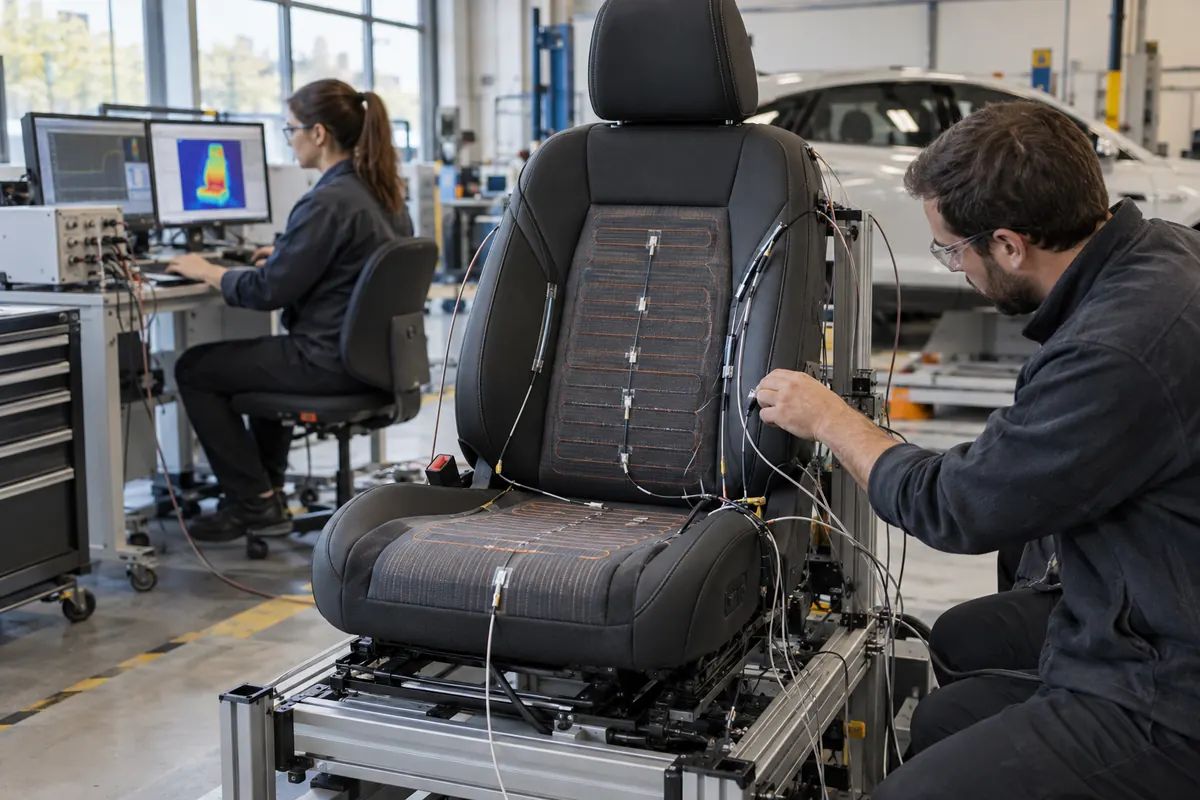
Testing must then cover more than normal operation. Engineers can deliberately simulate faulty readings and check whether protection still works. These tests need controlled equipment and procedures, not experiments on public roads.
With engineers approving every suggestion, AI can help flag missing fault responses and unclear safety requirements.
Want to see this in practice?
Book a demo